
 Australia
 Canada
 Cayman Islands
 Dominican Republic
 Hong Kong
 India
India
 Indonesia
 Ireland
 Jamaica
 New Zealand
 Singapore
 Thailand
 United Kingdom
 Vietnam

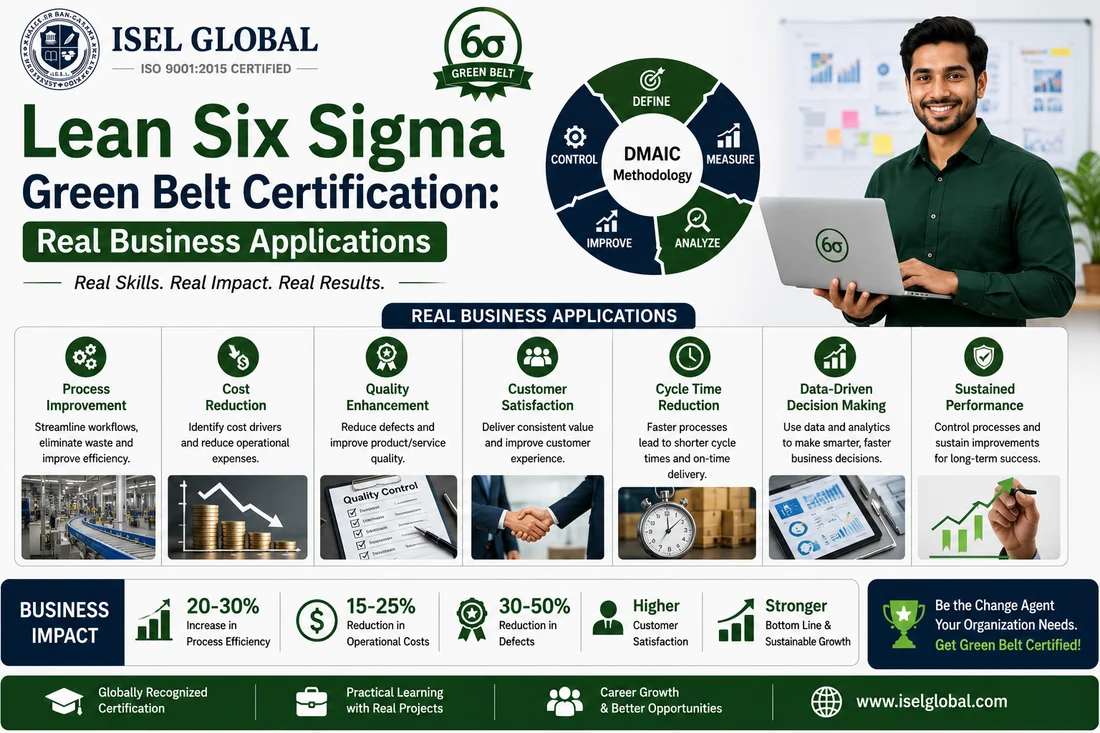
You have done QC checks. You have filled checklists. Now your manager wants “continuous improvement” and “data-driven decisions.” That’s where things get messy. The comparison between traditional quality management and Lean Six Sigma Green Belt is all you need to know. This is the reason you must opt for skill updation with ISEL Global.
In 2026, traditional quality keeps you compliant. Green Belt makes you valuable. ISEL Global trains beginners to cross that line, with real projects, not textbook talk.
Traditional Quality Management Is About Inspection FirstTraditional quality management lives at the end of the line. You make the product. Then you check it. You use gauges, check sheets, maybe a control chart. Part passes? Great. Fails? Scrap it or rework it. The goal is simple: don’t let bad stuff reach the customer. For manufacturing professionals and quality inspectors, this was the job for years. ISO audits, final inspection, customer complaints, all reactive.
The pain? You find problems after the money’s spent. A machine drifts. You catch it on piece 300. You’ve already lost time, material, and shift output. You’re good at catching fires. You’re not trained to prevent them. That worked when customers waited 4 weeks. In 2026, they won’t. Speed and cost now sit next to quality. That’s why the old way feels stuck.
Lean Six Sigma Green Belt Works Upstream, Not DownstreamA Lean Six Sigma Green Belt doesn’t hang out at the end of the line. You walk backward. You ask: “Where did the error start?” You map the steps. You time them with your phone. You talk to the operator who says, “It jams after lunch.” You measure, test, and fix that step. Lean kills waste, waiting, motion, overprocessing, stock. Six Sigma kills variation, the same task coming out different each shift. You use DMAIC. Define the pain. Measure what’s really happening. Analyze the cause. Improve with a small test. Control it so it sticks. At ISEL Global, Lean Six Sigma Green Belt Training means you pick a problem you face Tuesday morning. Billing delays. Label smears. Software bugs reopening. You don’t study someone else’s case. You fix yours. That’s why it sticks.
Lean Six Sigma Certification Brings Tools QC Never Taught You
QC gave you a hammer. Lean Six Sigma certification gives you a whole kit. You still use a run chart. But now you pull a Fishbone diagram and list every possible cause: man, machine, method, material, environment. You draw a Pareto and prove that 2 issues cause 70% of rework. You do a 5-Why in 4 minutes instead of blaming the “night shift.” For IT professionals, think of QC as restarting the app. Green Belt is finding the null pointer and fixing the code. One is a habit. The other is a cure. In 2026, companies want the cure. They want people who reduce cycle time, not just defect count. That’s why working professionals now sign up for Lean Six Sigma Green Belt instead of another audit course.
Six Sigma Green Belt Runs on Data, Not Gut Feel
Traditional quality leans on experience. “Sharma ji knows when the motor sounds off.” Useful. But Sharma ji retires next year. A Six Sigma Green Belt leans on numbers everyone can see. You video a process. You count defects per 50. You plot before/after on one slide. True story: A hospital in Indore had OPD wait times of 42 mins. Staff said, “patients come late.” Green Belt tracked it. Real bottleneck: insurance desk had one printer. Add a ₹1,200 printer, wait drops to 18 mins. No new hires. No arguments. Just data. That’s why business leaders ask Green Belts to meetings now. You don’t say “I feel.” You say “Data shows.” ISEL Global makes you practice that until it’s natural.
Six Sigma Green Belt vs QC Inspector: Different Jobs Entirely
QC inspector: checks output, fills report, moves on. Six Sigma Green Belt: asks why output failed, runs a small trial, updates the SOP, and tracks if it holds. Inspectors live at the end. Green Belts live across the process, with vendors, planners, even design. You lead a 3-week project. You don’t need a title. Students and junior engineers do it after training. This is why companies sponsor freshers for Green Belt. You become useful fast. You’re not waiting for permission to improve things. You find a ₹50K/month leak and plug it. That gets you noticed. That’s career growth, not just employment.
Where Black Belt Certification Fits After Green Belt
You’ll see black belt certification and wonder if you should jump. Hold on. Green Belts run part-time projects in their own area. A six sigma black belt runs big, cross-team projects full-time. They also coach Green Belts. Think scooter vs truck. Learn to ride before you haul. Some go higher, master black belt, six sigma master black belt. They set strategy and train Black Belts. But for beginners, that’s noise. Many Google best six sigma black belt certification in India or " six sigma black belt certification in Bangalore " on day one. Wrong order. Do Green Belt, deliver 2 projects, then decide. ISEL Global will tell you the same, build the base first.