Australia
 Canada
 Cayman Islands
 Dominican Republic
 Hong Kong
 India
 Indonesia
 Ireland
 Jamaica
 New Zealand
 Singapore
 Thailand
 United Kingdom
 Vietnam

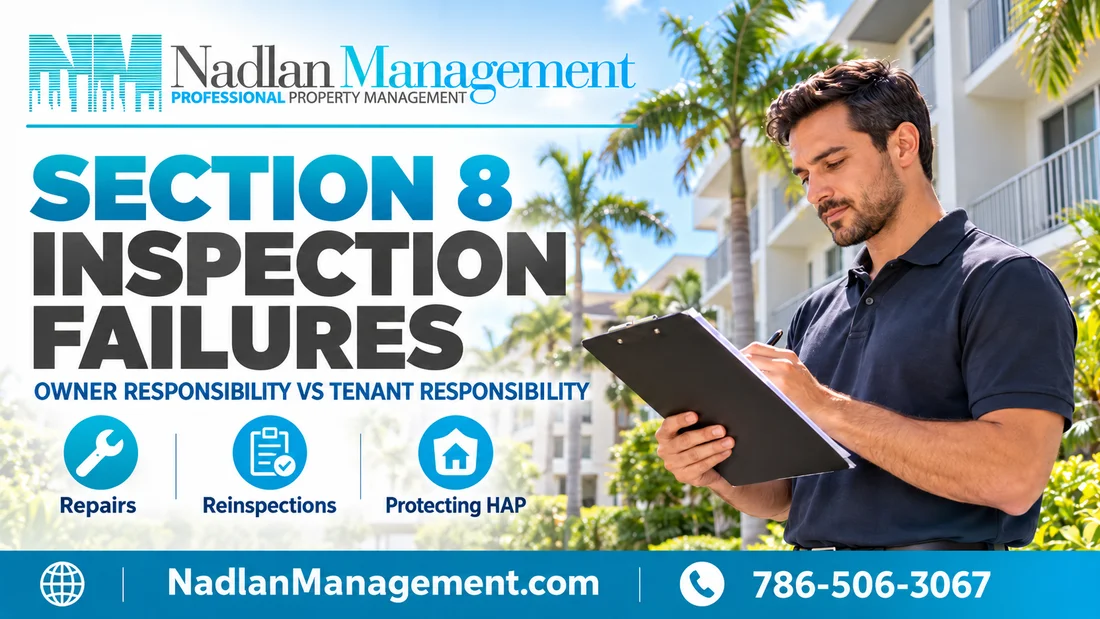
A failed Section 8 inspection can create real financial consequences for a landlord.
The important question is not simply whether the unit failed.
It is who is responsible for the failed item.
Miami-Dade’s Housing Choice Voucher program separates owner-responsibility violations from tenant-responsibility violations, and the consequences can be very different.
What Is Usually the Landlord’s Responsibility?
In general, the owner is responsible for Housing Quality Standards violations that are not specifically caused by the tenant.
That can include problems involving major building systems, plumbing, electrical issues, structural conditions, doors and windows, required equipment, or other property defects that the owner is expected to maintain.
Miami-Dade states that all other HQS violations, beyond certain family-caused violations, must be corrected by the owner.
If the owner is responsible, the repair deadline matters.
What Can Be the Tenant’s Responsibility?
Miami-Dade specifically identifies several types of violations that can be the family’s responsibility.
These include:
- failing to pay for utilities the tenant is responsible for
- failing to provide or maintain tenant-supplied appliances
- damage caused by the tenant or the tenant’s guests
- failing to provide access for inspections or required follow-up
The tenant is also responsible for allowing the housing agency access to the unit for inspections.
This distinction matters because a landlord should not automatically assume every failed item is their responsibility.
The Inspection Notice Should Identify Responsibility
After a failed inspection, Miami-Dade says the owner and tenant are notified of the failed items and whether the violation is considered the owner’s or tenant’s responsibility.
Owners should review that notice carefully.
Do not simply hand every item to a contractor before understanding how the violation was classified.
Emergency Failures Move Much Faster
Some violations are treated as emergencies.
Miami-Dade lists examples such as:
- no electricity
- no running water
- no gas where required
- gas leaks or dangerous fumes
- major plumbing leaks or flooding
- no functioning sanitary facilities
- electrical conditions creating a fire hazard
- severe property damage making the kitchen or bathroom unusable
Emergency violations generally require much faster correction than routine items.
Owners should treat these as immediate priorities.
What Happens If the Owner Does Not Make the Repairs?
This is where a failed inspection can become expensive.
If an owner does not correct an owner-responsibility violation within the required period, Miami-Dade can abate the Housing Assistance Payment.
That means the housing agency stops paying its portion of the rent.
The owner can still collect the tenant’s normal share, but the missing HAP amount is not something the owner can simply charge to the tenant.
The Owner Cannot Make the Tenant Cover the Abated HAP
This is an important rule.
Miami-Dade states that while HAP is abated, the tenant remains responsible for the tenant portion of rent, but the owner may not seek the abated housing-assistance amount from the tenant and may not use the abatement itself as a reason for eviction.
For an owner, that means a missed repair deadline can create a direct loss of rental income.
Abated Payments Are Not Automatically Recovered Later
Another major point: if payments are stopped because of owner noncompliance, Miami-Dade says retroactive HAP payments are not made for the abatement period.
So if an owner waits several weeks to complete a required repair, those missed housing-assistance payments may be permanently lost.
This is why Section 8 inspection failures should not be treated like ordinary maintenance requests.
What Happens After the Repair Is Completed?
Once the owner corrects the issue, the next step is generally to have the unit reinspected.
Miami-Dade states that an abated unit is inspected after the owner reports that the work has been completed.
Payment can resume once the unit passes inspection, assuming the lease and tenancy remain active.
Owners should not assume that completing the repair by itself automatically restarts payment.
The inspection process still has to be completed.
What If the Tenant Caused the Damage?
Tenant-caused damage can create a different situation.
If a tenant or guest damages the assisted unit beyond normal wear and tear, Miami-Dade can classify that as the family’s responsibility.
That is why documentation matters.
Owners should keep:
- photos
- maintenance records
- tenant communications
- vendor notes
- inspection notices
- move-in condition records when available
Good documentation can help establish whether a condition developed from normal property maintenance or from tenant-caused damage.
Access Problems Can Also Create Inspection Failures
A landlord can have every repair completed and still run into trouble if the inspector cannot access the unit.
Miami-Dade states that the participant must provide access for inspections and must also allow the owner reasonable access to make necessary repairs.
Repeated failure to provide access can become a program-compliance issue for the tenant.
Owners should document attempted access and communication whenever this becomes a problem.
Initial Inspections Are Different
Before a new Section 8 tenancy begins, the unit generally must pass inspection before final approval.
Miami-Dade’s current plan says that if the unit fails the initial inspection, the required repairs must be completed before approval can move forward. A reinspection is then scheduled, and if the unit still does not pass, the tenancy request can be cancelled.
That means owners should try to have the unit inspection-ready before the first appointment.
What Owners Should Do After Any Failed Inspection
When a Section 8 unit fails inspection, the owner should immediately determine:
- what failed
- who is responsible
- whether any item is considered an emergency
- the repair deadline
- whether tenant access is needed
- when the reinspection will occur
- whether HAP is at risk
- what documentation should be kept
The faster those questions are answered, the easier it is to protect the tenancy and rental income.
Section 8 Property Management in Miami
Nadlan Management provides property management services for Section 8 and other subsidized rental housing throughout Miami-Dade and Broward Counties.
Our services include tenant communication, maintenance coordination, rent collection, lease administration, bookkeeping and owner reporting.
For Section 8 landlords, understanding the difference between owner-responsibility and tenant-responsibility inspection failures can help prevent unnecessary delays, reduce lost HAP income and make repair decisions much clearer.
Learn more at NadlanManagement.com