
 Australia
 Canada
 Cayman Islands
 Dominican Republic
 Hong Kong
 India
India
 Indonesia
 Ireland
 Jamaica
 New Zealand
 Singapore
 Thailand
 United Kingdom
 Vietnam

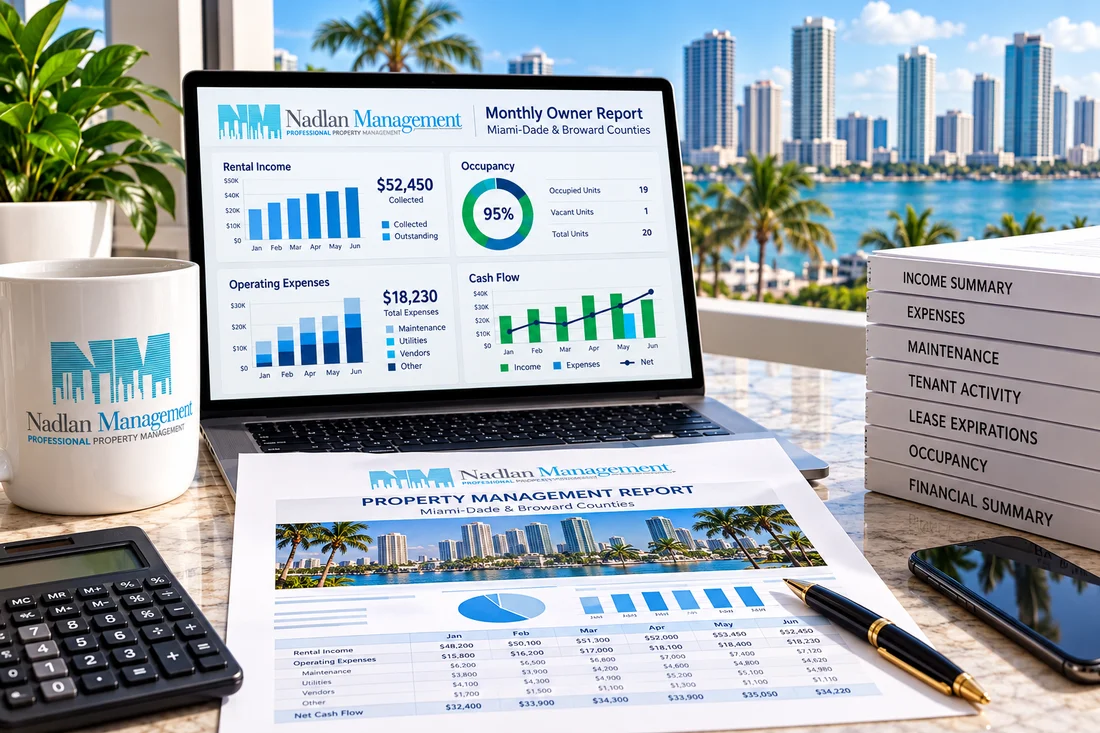
A monthly property management report should do more than show whether rent was collected.
For rental property owners in Miami-Dade and Broward Counties, a useful report should help explain how the property is performing, where money is being spent, and whether there are issues that may require attention.
The goal is not simply to provide paperwork.
The goal is to give the owner a clear, organized picture of the property without forcing them to reconstruct the month from bank transactions, receipts, emails and text messages.
Review Rental Income
A monthly report should clearly show the rental income received during the period.
Owners should be able to understand what rent was expected, what was collected and whether any balances remain outstanding.
For multifamily properties, this becomes even more important because several tenants may be paying different amounts at different times.
A clear income summary helps the owner understand the property's actual cash flow.
Track Outstanding Balances
A report should make it easy to identify unpaid or partially paid balances.
The owner should not have to search through separate messages to determine whether money is still owed.
Tracking balances consistently also helps reveal patterns, such as repeated late payments or tenants who regularly carry amounts forward.
Review Property Expenses
Owners should be able to see where money was spent during the month.
Typical property expenses may include maintenance, repairs, utilities, vendor invoices and other operating costs.
The purpose is not only to know the total amount spent.
A useful report should help the owner understand what the expenses were for and whether anything unusual occurred.
Look at Maintenance Activity
Maintenance can have a significant effect on property performance.
A monthly report should help the owner understand whether there were repair issues during the period and whether any of those issues are recurring.
One isolated repair may not be important.
Repeated calls involving the same system, unit or component may deserve closer attention.
Tracking maintenance over time can help owners make better long-term decisions.
Monitor Occupancy
Owners should know whether the property is fully occupied, partially vacant or approaching a turnover.
For multifamily properties, occupancy is one of the most important performance indicators.
A report that clearly shows vacant units and lease activity can help the owner understand whether lost income is becoming a concern.
Watch Upcoming Lease Expirations
Lease expirations can affect future income and vacancy.
A monthly review should make it easier to see which leases are ending soon so decisions are not made at the last minute.
Upcoming expirations may require the owner to think about renewal, rental rates, turnover planning or future marketing.
Knowing what is coming allows the owner to plan rather than react.
Compare Income and Expenses
One of the most useful parts of monthly reporting is seeing rental income and operating expenses together.
This helps the owner understand what the property actually produced during the month.
A property can have strong rental income but still underperform if expenses are unusually high.
Looking at both sides of the equation gives the owner a more complete picture.
Identify Unusual Changes
Good reporting can also help owners spot changes from month to month.
Examples may include higher maintenance costs, lower rental income, a new vacancy, repeated late payments, a large vendor expense, or multiple repairs in the same area.
The purpose is not to overreact to every change.
It is to notice patterns early enough to ask the right questions.
Understand Cash Flow
Owners should be able to understand how much money the property generated after normal operating activity.
Clear reporting helps separate gross rental income from the expenses required to operate the property.
This is especially important for investors who own more than one rental property.
Without organized reporting, it becomes difficult to compare one property with another.
Keep Records Organized
Monthly reports also create a useful historical record.
Over time, owners can review prior months to see how income, expenses, vacancy and maintenance have changed.
This can be valuable when evaluating the property's performance, planning future improvements or reviewing operating trends.
Good records make it easier to understand what has happened at the property without relying on memory.
Reporting Should Be Easy to Understand
A report can contain a lot of information and still be difficult to use.
Owners should be able to quickly understand the most important numbers and activity.
The report should provide enough detail to be useful without requiring the owner to spend hours interpreting it.
Clear organization is often more valuable than excessive complexity.
Monthly Reporting Helps Owners Stay Informed
Many property owners do not want to manage every daily detail of their rental property.
That does not mean they want to be disconnected from the investment.
Monthly reporting can help owners stay informed about income, expenses, occupancy, maintenance and other important activity while allowing day-to-day management to be handled separately.
Property Management and Owner Reporting in Miami-Dade and Broward
Nadlan Management provides full-service rental property management for property owners and real estate investors throughout Miami-Dade and Broward Counties.
We manage single-family rentals, multifamily and apartment properties, commercial properties and industrial rental properties.
Our services include leasing, tenant screening, rent collection, maintenance coordination, tenant communication, lease administration, bookkeeping and monthly owner reporting.
Learn more at NadlanManagement.com