Australia
 Canada
 Cayman Islands
 Dominican Republic
 Hong Kong
 India
 Indonesia
 Ireland
 Jamaica
 New Zealand
 Singapore
 Thailand
 United Kingdom
 Vietnam

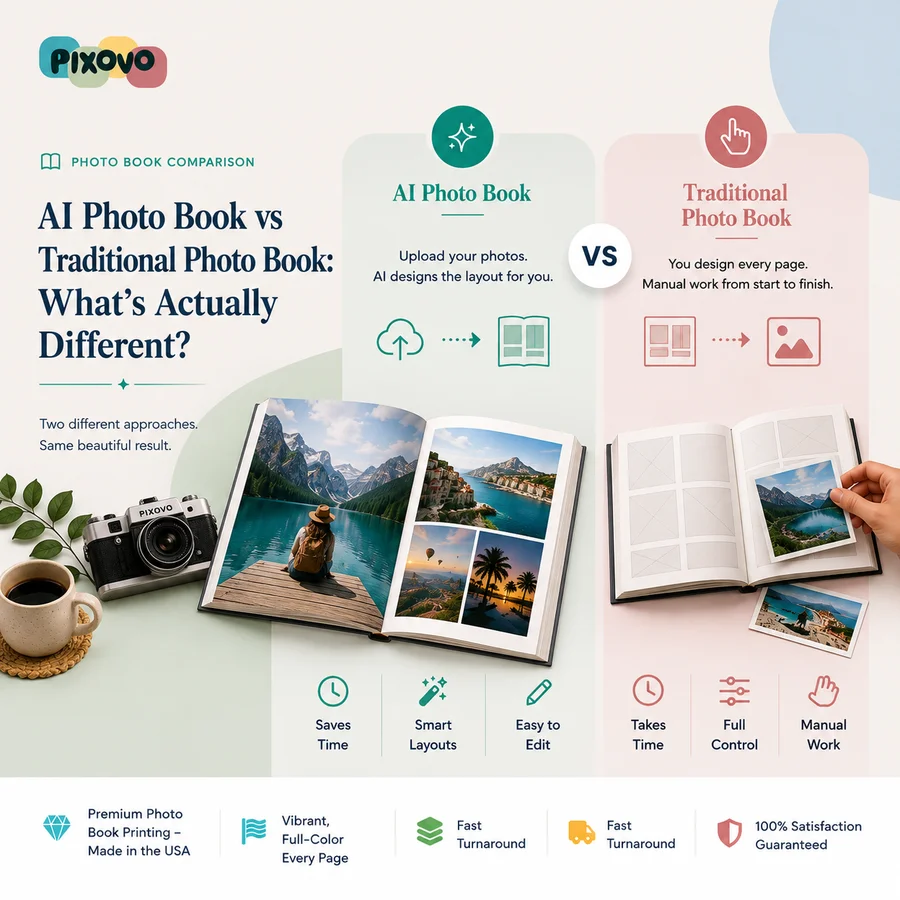
An AI photo book vs traditional photo book comes down to one thing: who does the design work. A traditional photo book puts every layout decision on you pick a template, place each photo, repeat for every page. An AI photo book, like the ones you build on Pixovo, uploads your photos and lets automatic photo book layout software design the pages for you to review and fine-tune from there instead of starting from a blank page.
Quick Summary
AI photo book: you upload photos, the software designs the layout automatically, then you edit and order.
Traditional photo book: you manually place every photo on every page yourself, using photo book design software as a blank canvas.
Time difference is the biggest gap. A full book that takes 45+ minutes manually often comes together in minutes with AI-assisted layout.
AI wins on speed and ease for large or unsorted photo batches; traditional tools win when you want full manual control over every page.
Pixovo is built AI-first, with editing available after the first draft, not a manual-only tool.
What Is an AI Photo Book?An AI photo book is a printed photo book whose page layout was designed automatically by software, not placed page-by-page by hand. You upload your photos, the AI groups and arrange them across every page at once, and you're left reviewing and adjusting a finished first draft rather than building one from scratch. This is the core mechanism behind Pixovo's AI photo book builder: upload photos, let the AI design a personalized layout automatically, then fine-tune colors, text, or theme before ordering.
What Is a Traditional Photo Book?A traditional photo book is built using template-based photo book design software, where every layout decision which photo goes where, how it's cropped, how many photos share a page is made manually by the person creating it. The software provides the canvas and the tools; you provide every decision. This gives complete creative control, but it also means the work scales directly with how many pages and photos you're working with.
AI Photo Book vs Traditional Photo Book: Side-by-SideTraditional Photo Book
AI Photo Book
Time to finish a layout
45+ minutes for a full book, page by page
Minutes, from upload to first draft
Design skill needed
You choose every layout and placement
None required AI builds the draft, you fine-tune
Best for
Small, curated photo sets, full manual control
Large or unsorted photo batches, gifts on a deadline
What you still do
Everything
Review, swap photos, adjust colors/text/theme
The main AI photo book benefits are speed, accessibility, and consistency. Speed, because automatic photo book layout removes the single biggest reason people abandon a photo book project halfway through: the repetitive manual work of placing every photo one at a time. Accessibility, because no design experience is needed the AI makes the first round of layout decisions, so someone who's never used photo book design software before ends up with a professional-looking result. Consistency, because the AI balances photos and spacing across every page using the same logic throughout, rather than the layout quality drifting as a person gets tired of manually placing photos halfway through a long book.
The Manual Process, Step by StepPick a template or blank layout for each page
Choose which photos go on which page
Resize, crop, and position each photo by hand
Repeat for every page a 20-page book means making these decisions 20+ times over
Review the finished book for consistency, since nothing was automatically balanced across pages
The AI Process, Step by StepUpload your photos from your phone, computer, or social platform
The AI groups them and builds a first-draft layout automatically across every page
Review the draft and swap out any photo, or adjust colors, text, or theme
Order once you're happy with the result
Where Traditional Tools Still WinManual, template-based photo book design software gives you full page-by-page control. If you want to place one specific photo in one specific spot on one specific page for a reason only you know, a manual tool lets you do exactly that. An AI-designed layout is a first draft you edit, not a blank canvas you build from nothing for someone who wants to make every layout decision themselves, that's a genuine trade-off, not a flaw.
Where AI Tools WinAI-assisted layout wins clearly on three things: speed, accessibility for people with no design background, and handling large or unsorted photo batches well. A few hundred unsorted phone photos are exactly the situation where manual layout becomes the reason a project never gets finished — automatic photo book layout removes that barrier entirely.
How to Choose the Best AI Photo Book AppNot every AI photo book app works the same way. When comparing options, look at three things: how much of the layout is actually automated versus just a slightly smarter template picker, whether you can still edit the AI's first draft (colors, text, theme, photo swaps), and where the book is actually printed and shipped from, since that affects both quality and delivery time. Pixovo is built around a full AI-first layout with editing available afterward, printed in the USA see the full breakdown of how Pixovo and other services compare for a side-by-side look at pricing and features across the top options.
Ready to Try It?Upload your photos and let AI design your book automatically.
Create your photo book free and see your layout in minutes.
FAQ
Do AI photo books look generic or all the same?
No the layout is built from your specific photos (how many, their orientation, how they group together), so different photo sets produce different layouts rather than one fixed template stretched over everything. Colors, text, and theme can also be adjusted afterward.
Can I still edit an AI-designed photo book, or is it locked once generated?
With Pixovo, the AI builds the layout automatically and you fine-tune colors, text, or theme from there, it's a starting point you edit, not a locked final result.
Is an AI-designed photo book lower print quality than a manually designed one?
No, the AI only affects layout decisions, not printing, paper, or binding. Print quality is identical either way what changes is how much of the design work you do yourself.
Which is better for a last-minute gift?
An AI photo book, since the biggest time cost in a traditional photo book is the manual layout work removing that step is what makes a same-week gift realistic.