
 Australia
 Canada
 Cayman Islands
 Dominican Republic
 Hong Kong
 India
India
 Indonesia
 Ireland
 Jamaica
 New Zealand
 Singapore
 Thailand
 United Kingdom
 Vietnam

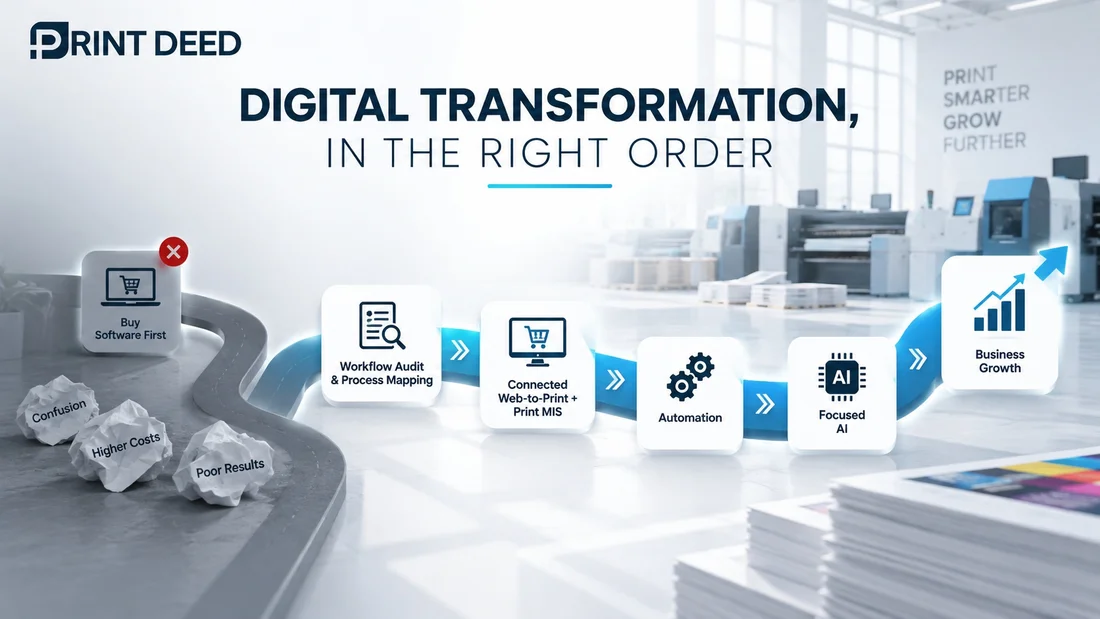
Most print businesses that attempt digital transformation do not fail because they picked the wrong software. They fail because they started in the wrong place. A new web to print storefront gets bolted onto the same disconnected estimating process. A print MIS gets purchased and half configured because nobody mapped the actual production workflow first. Six months later, the owner has spent real money and the shop still runs on the same manual handoffs it always did, just with an extra login screen.
For print shop owners, commercial printers, print brokers, and in plant print departments across the USA and Canada, this is a genuinely common pattern. It is also avoidable, and the fix is less about technology and more about sequencing.
Why Digital Transformation Projects StallIndustry guidance on this topic, including a roadmap published by SumnerOne for print service providers, points to the same handful of failure points showing up again and again: starting a rollout too broadly with unrealistic expectations, moving forward without a clear vision or concrete plan, keeping a rigid organizational structure that resists change, leaving frontline employees out of the planning process, and losing sight of customer needs somewhere in the middle of implementation.
None of these are technology problems. They are sequencing and change management problems, which is exactly why buying better software rarely fixes them on its own.
Phase One: Take an Honest Inventory Before Buying AnythingBefore evaluating a single vendor, a print business needs a clear picture of where time and accuracy actually break down today. Where do orders get delayed between quote and production. Where do pricing errors happen most often. Which parts of the process still depend on a phone call, a spreadsheet, or an email thread that only one person fully understands.
This step gets skipped constantly because it is less exciting than picking new software, but it is the difference between a rollout that fixes the actual bottleneck and one that adds a new tool on top of the old problem.
Phase Two: Sequence Web to Print and Print MIS Together, Not SeparatelyA common mistake is treating a customer facing storefront and a back end print MIS as two separate projects on two separate timelines. In practice, they need to be planned as one system from the start. An order placed through a web to print interface is only valuable if it flows directly into accurate estimating, correct production routing, and real time inventory, without someone re-entering the same information by hand.
We covered the mechanics of that integration in more detail in Web to Print Software Explained, which is worth reading alongside this roadmap if MIS integration is the phase a business is currently evaluating.
Phase Three: Automate the Repetitive Steps, Not the Judgment CallsWorkflow automation delivers the fastest, most measurable return when it targets clearly repetitive tasks: pre press file checks, order routing based on job specifications, production status notifications, and reorder flows for repeat B2B accounts. These are steps with a right answer that a system can apply consistently, faster than a person can, every time.
Automation delivers a much weaker return, and sometimes actively frustrates staff and customers, when it is pointed at steps that genuinely require judgment, like handling an unusual customer request or resolving a production exception. A useful rule of thumb during this phase is to automate the parts of the workflow that are boring and repetitive, and keep people in the loop for anything that requires a real decision.
Phase Four: Layer in AI Where It Solves a Specific, Named ProblemAI in printing is genuinely useful right now, not as a blanket upgrade, but applied to specific, well defined problems: catching low resolution artwork before it reaches a press, answering routine order status questions around the clock, flagging maintenance issues before they cause downtime, and optimizing color correction on digital output.
The businesses getting real value from AI tend to introduce it one use case at a time, measure whether it actually reduced errors or support volume, and expand from there. The businesses that struggle tend to buy an AI feature because it was in the sales pitch, without a specific problem it was meant to solve.
Phase Five: Bring Employees Into the Plan, Not Just the RolloutThe failure points identified in SumnerOne's roadmap research keep coming back to the same theme: transformation efforts that are designed and announced from the top, without involving the people actually running production day to day, tend to stall regardless of how good the technology is. Staff who understand exactly where the current process breaks down are also the people most likely to spot a flaw in a new workflow before it goes live, and most likely to resist a system they had no input on.
This does not need to be complicated. It usually means walking the actual production floor with the people running it, asking where the new system will create friction, and adjusting before launch rather than after.
Phase Six: Treat This as a Growth Decision, Not a Maintenance ProjectThis is the point where digital transformation stops being a technology upgrade and becomes a growth strategy. A print business with an integrated web to print storefront, a connected print MIS, targeted automation, and AI applied to specific problems is not just running more efficiently. It is positioned to absorb more volume without adding proportional headcount, which is precisely the structural gap that keeps marketing driven growth from turning into operational chaos, a pattern examined more closely in The Print Industry's Quiet Crisis.
It also changes how a business shows up to buyers researching vendors through AI powered search tools, since the kind of specific, well documented operational maturity described here is exactly what tends to get cited as credible expertise, a topic covered in How Print Businesses Get Found by AI Search.
A Short Checklist Before StartingHas the actual bottleneck been identified, rather than assumed.
Are the web to print and print MIS pieces being planned as one connected system.
Is automation being aimed at repetitive steps rather than judgment calls.
Does every AI feature being considered solve one specific, named problem.
Have the people running production been part of the planning conversation, not just told about the rollout afterward.
This is the exact sequence a specialized partner like PrintDeed works through with print and print on demand businesses across the USA and Canada, precisely because skipping a step here is what usually turns a promising digital transformation project into an expensive piece of shelf ware.
The Bottom LineDigital transformation in print does not fail because the technology is bad. It fails because businesses buy the technology before doing the sequencing work that makes it useful. Take stock honestly, plan web to print and print MIS together, automate the repetitive steps first, apply AI to specific named problems, and bring the production team into the plan early. Businesses that follow that order tend to see transformation efforts stick. Businesses that skip it usually end up paying for software that never quite gets used the way it was supposed to