Australia
 Canada
 Cayman Islands
 Dominican Republic
 Hong Kong
 India
 Indonesia
 Ireland
 Jamaica
 New Zealand
 Singapore
 Thailand
 United Kingdom
 Vietnam

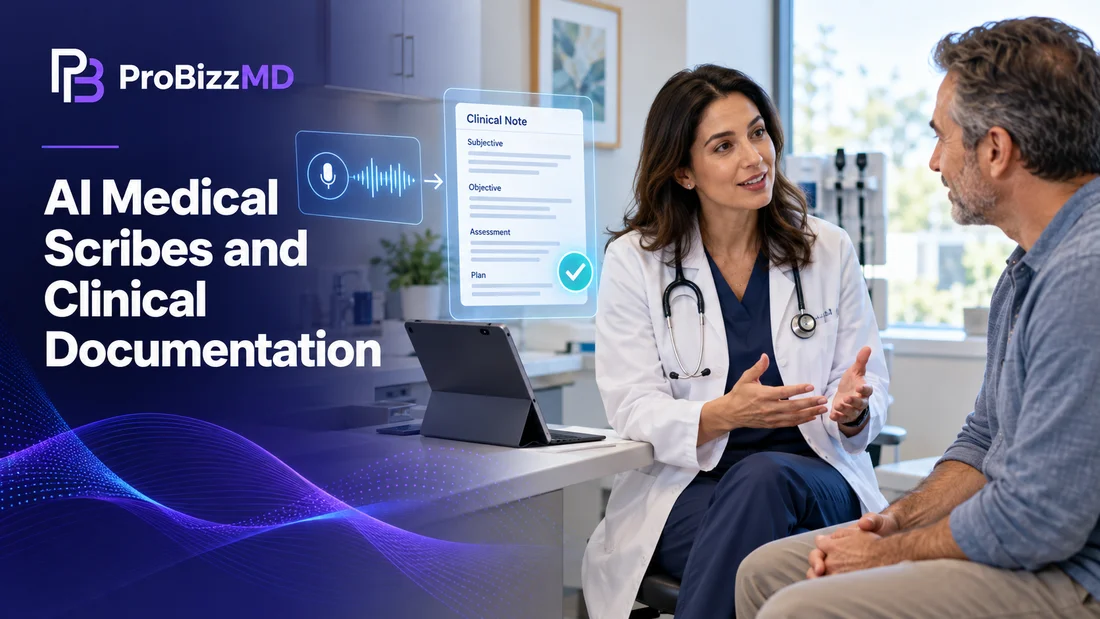
AI medical scribes are changing how clinicians turn patient conversations into medical records. Instead of typing every detail during or after an appointment, a clinician can use an ambient documentation tool to capture the encounter, identify clinically relevant information, and generate a draft note for review. The promise is appealing: less time at the keyboard, better attention during the visit, and faster completion of charts.
The technology is not an autonomous clinician, coder, or compliance officer. An AI-generated note can omit context, misstate a fact, add unsupported language, or place information in the wrong section. The treating professional remains responsible for reviewing, correcting, and signing the record. A successful program therefore combines useful automation with clinical judgment, privacy controls, standardized workflows, and ongoing quality measurement.
An AI medical scribe is software that uses speech recognition and natural-language processing to convert a clinical conversation into structured documentation. Many products operate in the background during an in-person or telehealth visit. After the encounter, the system produces a draft that may include the history, assessment, plan, medications, orders, or other sections configured for the specialty and EHR workflow.
Traditional human scribes document under the direction of a clinician. Voice dictation transcribes what the user deliberately dictates. An ambient AI scribe attempts to identify relevant content from the natural conversation and organize it into a note. That difference makes the tool convenient, but it also makes review essential because the software is interpreting context rather than simply copying dictated words.
Method
Primary input
Typical output
Human responsibility
Manual documentation
Clinician typing
Completed note
Create and verify the full record
Voice dictation
Deliberate spoken narrative
Transcript or formatted text
Edit, structure, and sign
Human scribe
Observed encounter
Draft note
Direct, review, correct, and sign
AI medical scribe
Ambient encounter audio
Structured draft note
Validate every material fact and finalize
The exact architecture varies by vendor, but the practical workflow usually follows six stages.
The practice configures users, specialties, templates, consent procedures, and EHR access.
The tool captures or processes the encounter audio according to the approved workflow.
Speech-recognition technology converts the conversation into machine-readable text.
The system identifies clinical concepts and organizes them into the selected note structure.
A draft is presented to the clinician for review, correction, and approval.
The finalized note is entered or transferred to the EHR, where downstream coding and billing workflows begin.
Practices should confirm whether audio is stored, where processing occurs, how long information is retained, whether vendor personnel can access it, and whether data is used to train models. Marketing terms such as ambient, automatic, or HIPAA compliant, do not answer these operational questions.
The strongest use case is reducing repetitive documentation work. AMA reporting on real-world deployments describes physicians using AI scribes frequently and organizations reporting substantial time savings. The benefit is not guaranteed for every specialty or clinician, but a well-designed workflow can reduce after-hours charting and help notes reach completion sooner.
When clinicians are not continuously switching between the patient and keyboard, the encounter may feel more conversational. This can support eye contact and active listening. Patient comfort still matters; the practice should explain the tool, follow applicable consent requirements, and provide an alternative when appropriate.
Templates can help clinicians document recurring elements consistently. That does not mean longer is better. Notes should remain clinically relevant, readable, and specific to the encounter. Copy-forward language, generic normal findings, or unsupported detail can create risk even when the note appears polished.
A completed, accurate note gives coding and billing teams the information needed to evaluate the documented service. Earlier note closure may reduce charge lag, but an AI scribe does not select compliant codes automatically merely because it generated the narrative. Coding must reflect the services documented and applicable payer rules.
AI medical scribes can support the revenue cycle indirectly when they help clinicians finish accurate notes promptly. Clear documentation may help coders identify the service performed, medical necessity, relevant diagnoses, time, procedures, and other claim-supporting facts. Timely completion can also reduce delayed charge entry.
The opposite is also possible. A fluent but inaccurate draft can introduce contradictions, unsupported diagnoses, incorrect medication details, or missing procedure information. If those errors reach coding, the result may be a rejected claim, denial, audit concern, repayment risk, or inaccurate patient record. The financial value of an AI scribe therefore depends on note quality and the controls surrounding it not on note volume alone.
Documentation issue
Possible revenue-cycle effect
Control
Missing service detail
Coder query or undercoding
Specialty template and clinician review
Unsupported statement
Overcoding or audit exposure
Remove unverified content before signing
Late note completion
Charge lag and delayed claim
Track time from visit to signed note
Wrong patient or encounter context
Patient-safety and billing error
Identity confirmation and interface testing
Template bloat
Important facts become hard to find
Audit relevance, clarity, and duplication
EHR interface failure
Incomplete or duplicate note
Exception queue and reconciliation
Practices that want documentation quality connected with claims performance can review ProBizzMD Medical Billing Services at The most useful review documentation gaps to coding queries, denials, charge lag, and accounts-receivable outcomes.
An AI scribe may create, receive, maintain, or transmit protected health information on behalf of a healthcare provider. HHS explains that a vendor performing such functions can be a business associate and that the covered entity generally needs appropriate written assurances through a Business Associate Agreement. The agreement should define permitted uses, safeguards, reporting duties, subcontractor responsibilities, and return or destruction of information.
A signed BAA is necessary in many vendor relationships, but it is not the entire security review. The HIPAA Security Rule requires appropriate administrative, physical, and technical safeguards for electronic protected health information. Practices should perform risk analysis, restrict access, configure authentication, review audit logs, manage devices, plan incident response, and understand every downstream service that handles the data.
Is audio retained, and can retention be disabled or limited?
Where are audio, transcripts, drafts, and logs processed and stored?
Is customer data used to train shared models, and can that use be prohibited?
Which subcontractors or cloud services handle PHI?
How are data encrypted in transit and at rest?
Does the product support role-based access, multifactor authentication, and audit logging?
How are errors, security incidents, and breaches reported?
How is information exported, returned, or destroyed when the contract ends?
What patient notice or consent process is required under applicable federal and state law?
AI-generated prose can sound confident even when it is incomplete or wrong. The risk increases when several people speak, terminology is unusual, audio quality is poor, or the conversation contains ambiguity. Specialty vocabulary, accents, pediatric encounters, interpreters, behavioral health conversations, and telehealth audio can require additional testing.
Hallucinated or unsupported facts
Omitted symptoms, negatives, or treatment details
Incorrect speaker attribution
Medication, dosage, laterality, or date errors
A note that does not reflect clinical reasoning
Excessive text that hides relevant information
Automation bias, where reviewers accept a polished draft too quickly
Inconsistent performance across specialties, visit types, or languages
The clinician should never sign a note merely because it reads naturally. Review should confirm patient identity, history, findings, assessment, plan, orders, medications, time when relevant, and any elements that may affect care or coding.
The best AI medical scribe is not the product with the longest feature list. It is the one that performs safely in the practice’s real encounters, fits the EHR workflow, protects patient information, and produces measurable improvement without creating new correction work.
Evaluation area
Questions to ask
Clinical fit
Does it support the specialty, note types, terminology, and visit formats?
Accuracy
How is quality measured, and can the practice run a controlled pilot using real workflows?
EHR workflow
Is the integration direct, reviewed, reversible, and resistant to duplicate notes?
Privacy and security
Is there a BAA, clear retention policy, subcontractor disclosure, encryption, access control, and incident process?
Governance
Can administrators manage templates, permissions, audit logs, and exception workflows?
Commercial terms
What is charged per clinician, encounter, minute, interface, or feature?
Data rights
Who owns the recordings, transcripts, drafts, feedback, and exported records?
Support
Who handles implementation, outages, specialty tuning, and contract exit?
Measure current documentation time, after-hours EHR work, unsigned notes, charge lag, coding queries, and clinician experience. Without a baseline, the practice cannot tell whether the product solved the intended problem.
Map how information moves through the product. Review the BAA, security documentation, retention settings, model-training terms, subcontractors, breach obligations, data export, and termination provisions with qualified privacy, security, and legal personnel.
Start with a small group of willing clinicians and representative visit types. Do not use only simple encounters. Include specialty vocabulary, telehealth, multiple speakers, and situations that commonly create documentation difficulty.
Create a standard review checklist and make clear that the clinician remains responsible for the signed note. Define how corrections are made and how serious errors are reported to the vendor and internal leaders.
Monitor whether signed notes arrive earlier, coder queries fall, charge lag changes, and documentation-related denials improve. Do not treat note length or number of generated notes as evidence of financial value.
Expand only after the pilot shows acceptable accuracy, security, usability, support, and measurable benefit. Retain a downtime process so patient care and documentation can continue when the service or interface is unavailable.
Metric
What it indicates
Minutes spent documenting per encounter
Whether documentation effort falls
After-hours EHR time
Whether pajama-time charting improves
Time from visit to signed note
Whether notes close sooner
Correction time per draft
Whether automation creates hidden rework
Material error and omission rate
Whether documentation is safe and reliable
Coder query rate
Whether notes answer billing questions
Charge lag
Whether documented services reach billing sooner
Documentation-related denial rate
Whether claim support improves
Clinician and patient feedback
Whether the workflow improves the encounter
How ProBizzMD Supports the Documentation to Revenue Cycle Handoff
ProBizzMD does not replace clinical judgment or select an AI scribe for a practice. Its role is to help healthcare organizations connect completed documentation with billing and revenue-cycle workflows. Depending on the agreed scope, that can include claims submission, coding coordination, rejection management, denial follow-up, payment posting, accounts-receivable work, and reporting.
AI medical scribes can reduce documentation burden and help clinicians focus more attention on patients, but their value depends on responsible implementation. The tool should create a draft, not replace the clinician’s judgment. Strong programs combine human review, HIPAA-aware contracting, security controls, specialty testing, patient communication, and measurable workflow goals.
For practices evaluating how documentation quality affects coding, claims, denials, and cash flow, ProBizzMD can review the operational handoff between the clinical record and the revenue cycle. Request a medical billing and RCM workflow review based on your specialty, payer mix, systems, and current performance.
It is software that processes a clinical conversation and creates a structured draft note for the clinician to review, correct, and sign.
No. The treating professional remains responsible for the accuracy, relevance, and final approval of the medical record.
Compliance cannot be determined from a label alone. Evaluate the specific workflow, BAA, safeguards, retention, access controls, subcontractors, and the practice’s own configuration and use.
Requirements can vary by jurisdiction, recording law, setting, product, and organizational policy. Obtain qualified legal guidance and use a clear patient communication process.
It may support earlier and clearer documentation, but inaccurate or unsupported notes can create coding, denial, audit, and patient-safety risks. Human review remains essential.
Confirm patient identity, history, findings, assessment, plan, medications, orders, time when relevant, and all facts that could affect care or coding.
Compare specialty fit, tested accuracy, EHR workflow, privacy and security, governance, support, data rights, total cost, and measurable pilot results.
Retention should be limited to a documented purpose and aligned with applicable law, contracts, risk assessment, and organizational policy. Ask whether retention can be disabled or shortened.
The central risk is trusting fluent text without verifying it. A polished draft can still contain omissions, misattributions, or unsupported statements. Contact with Expert Team