Australia
 Canada
 Cayman Islands
 Dominican Republic
 Hong Kong
 India
 Indonesia
 Ireland
 Jamaica
 New Zealand
 Singapore
 Thailand
 United Kingdom
 Vietnam

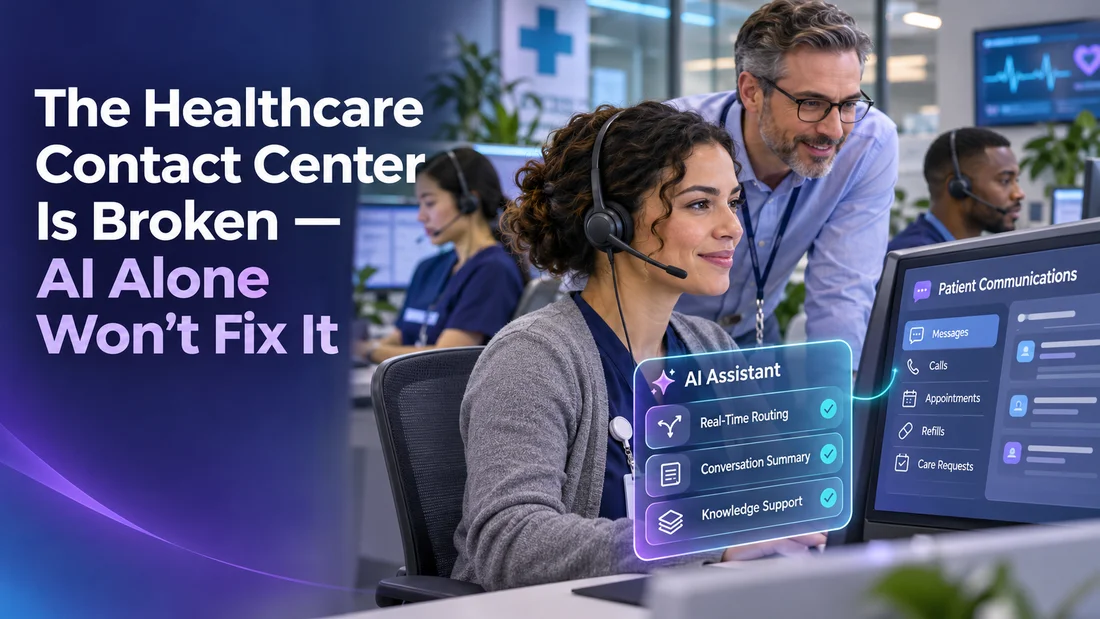
Healthcare contact centers are not failing because they lack artificial intelligence. They are failing because patients face disconnected phone trees, repeated transfers, fragmented systems and unclear ownership. AI can improve routing, summaries and repetitive work, but adding automation to a broken workflow can simply make a poor experience faster.
The better approach is a human-led, AI-assisted contact center: redesign the patient journey, give staff reliable information and authority, Healthcare contact center AI connect clinical and revenue-cycle workflows, apply privacy and safety controls, and automate only where it removes friction without blocking access to a person.
A patient may call because a claim was denied, a balance looks wrong, a referral is missing, medication needs attention or an appointment must change. The patient experiences one problem; the organization sees separate departments and systems. Healthcare contact center AI
Long menus force patients to guess who owns the issue.
Identity verification and explanations are repeated after transfers.
Agents switch between the EHR, scheduling, CRM, payer portals and billing software.
Outdated scripts create inconsistent answers.
No single person owns an unresolved request through closure.
Language, accessibility and after-hours options are limited.
Targets reward short calls instead of correct outcomes.
These are operating-model problems. A chatbot cannot repair missing ownership, poor escalation rules or inaccurate source data.
Natural-language routing can recognize scheduling, billing, eligibility, Healthcare contact center AI referral, refill or clinical-triage needs without forcing every caller through the same menu. A clear human option remains essential when intent is uncertain or the matter may be urgent.
An approved knowledge assistant can surface current policies, payer instructions and next-step checklists while the agent is speaking with the patient. Answers should link to controlled sources so staff can verify them.
AI can draft a summary, disposition and follow-up task. The agent should review material details before anything enters the official record. Automation must not invent clinical facts, promise coverage or create an unverified commitment.
Analytics can identify repeated transfers, unresolved callbacks, compliance gaps and emerging demand. Human reviewers should validate findings and use them for coaching and process improvement.
Automation works well for defined tasks such as office hours, appointment status and approved preparation instructions. It should escalate when a patient repeats a question, asks for a person, expresses distress or presents a request outside the approved scope.
Problem
Why AI Alone Fails
Required Change
Fragmented systems
It may summarize conflicting data but cannot make it reliable.
Integrations, data governance and a source of truth.
No case owner
Automation can create another ticket without closure.
Named ownership, service levels and escalation paths.
Outdated knowledge
AI can confidently repeat obsolete instructions.
Content owners, approval dates and version control.
Understaffing
Deflection may hide demand while complex queues grow.
Capacity planning based on contact reasons and skills.
Poor accessibility
Voice bots and chat may create new barriers.
Accessible channels, language support and human alternatives.
Wrong metrics
AI may optimize a harmful target.
Measures tied to resolution, safety and trust.
Automate: predictable, reversible and low-risk tasks with approved answers.
Assist: provide summaries, knowledge and workflow prompts while employees remain responsible for final actions.
Escalate: route clinical, financial, emotional, accessibility and exception cases to trained people with full context.
Patients should not restart after escalation. Staff should receive the contact reason, completed verification, prior actions and relevant history—subject to role-based access and minimum-necessary rules.
Use contact reasons, complaints, portal messages and staff interviews to follow work across scheduling, referrals, authorizations, billing and clinical teams. The best automation opportunity may be a handoff that should not exist.
Define who owns each request, the expected response time, escalation threshold and evidence of closure. “Transferred to billing” is not an outcome; “balance corrected and patient notified” is.
Every approved answer needs a source, owner, review date, applicable payer or location and escalation instruction. AI retrieval is only as dependable as its knowledge.
Choose one friction point, establish a baseline, pilot with a limited group and review errors. Expand only when the workflow improves efficiency and patient outcomes.
Escalation should cover repeated misunderstanding, sensitive financial conversations, possible clinical urgency, complaints, disability accommodations, language needs and low-confidence AI results.
Contact-center tools may create, receive, maintain or transmit protected health information. Complete risk analysis, apply role-based access, review recording and transcription, define retention, monitor access and determine when a business associate agreement is required. HHS guidance emphasizes reasonable safeguards, identity verification and risk management for communication technologies handling electronic PHI.
Average handle time should never stand alone. A short call that produces a repeat call, missed appointment or incorrect balance is not efficient.
First-contact resolution and repeat-contact rate
Transfer, abandonment and time to final resolution
Promise-kept rate for callbacks and follow-up tasks
Accuracy, compliance and documentation quality
Patient effort and experience across channels
Downstream impact on no-shows, denials, aging AR and rework
Equity and accessibility across languages and patient groups
Employee experience, cognitive load and knowledge-search time
The contact center is part of the revenue cycle. Incorrect insurance data, missed authorization messages, unclear balances, unresolved denials and failed payment follow-up create avoidable work and lost revenue.
A strong workflow should connect patient communication with revenue cycle management, medical billing, eligibility verification, denial management and provider credentialing. Agents need enough context to explain next steps without making unsupported coverage or payment promises.
Document each tool’s purpose, users, data and prohibited uses.
Test realistic accents, languages, noise levels and edge cases.
Disclose automation when appropriate and provide human assistance.
Set confidence thresholds and fail safely.
Require human review for clinical, coverage and material financial decisions.
Log recommendations, overrides, errors and patient-impacting incidents.
Review vendor security, subcontractors, retention and model-training terms.
Monitor unequal error rates and accessibility barriers.
Create incident-response and rollback procedures before launch.
No. AI can handle selected routine tasks and assist staff, but healthcare conversations often involve exceptions, emotion, privacy, financial consequences and possible clinical urgency. Human accountability remains essential.
A narrow, low-risk use case such as knowledge search, intent routing or draft summaries is usually safer than launching an autonomous patient-facing system.
Covered entities and business associates must apply relevant HIPAA requirements to the PHI they create, receive, maintain or transmit. Privacy, security and legal teams should review the implementation.
No single KPI is sufficient. Resolution, repeat contacts, accuracy, patient effort and downstream outcomes should be considered together.
Use approved sources, narrow scope, confidence thresholds, citations for agents, human review and continuous sampling of real interactions.
Yes. A clear human path supports accessibility, trust, exceptions and safety. The escalation should preserve context.
The healthcare contact center will not be repaired by buying a smarter bot. It improves when the organization removes unnecessary handoffs, establishes ownership, governs knowledge, protects patient data, supports employees and measures completed outcomes. AI belongs inside that redesigned system as an assistant—never as a substitute for accountability, empathy or safe access to care.
If your U.S. healthcare organization needs help connecting patient communication with billing, denials, AR follow-up and payer workflows, contact ProBizzMD for a practice-specific review.
Prepared for ProBizzMD by Babar Ali, SEO expert, web developer, social media professional, and content creator. This article provides general educational information for U.S. healthcare organizations. It is a legal, clinical, coding, contracting, or payer advice. Forms, contacts, criteria, networks, and rules can change. Verify current requirements with Claritev, the applicable payer, CAQH, state regulators, and the controlling agreement before submission or billing.