Australia
 Canada
 Cayman Islands
 Dominican Republic
 Hong Kong
 India
 Indonesia
 Ireland
 Jamaica
 New Zealand
 Singapore
 Thailand
 United Kingdom
 Vietnam

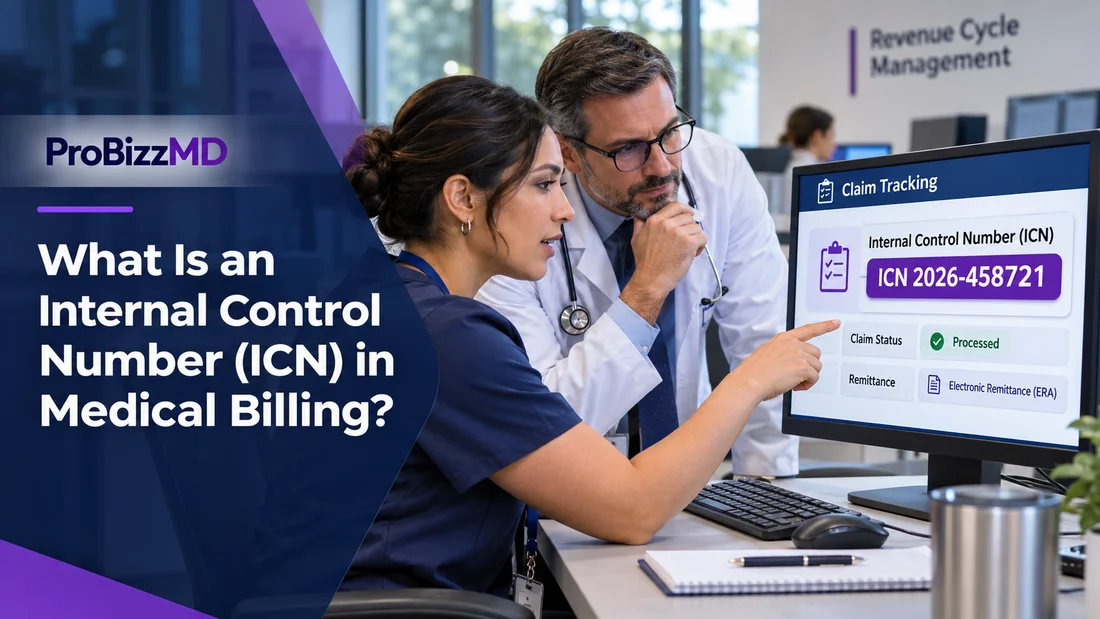
An Internal Control Number, usually called an ICN, is a unique claim identifier assigned by a payer or its claims-processing contractor. ICN in medical billing It lets the payer and the provider refer to the same processed claim when checking status, reading a remittance, correcting data, requesting a review, or following up on a denial.
The practical rule is simple: use the payer-assigned number shown for the exact claim version you are working on. Do not substitute the practice account number, clearinghouse batch number, authorization number, ICN in medical billing or payment trace. Those identifiers serve different purposes, and mixing them can lead to rejected corrections, duplicate submissions, or a broken appeal trail.
What an ICN Does in the Claim Lifecycle
A claim can pass through several systems before payment. The practice creates its own account or claim number, ICN in medical billing the clearinghouse creates transmission references, and the payer creates a control number after the claim reaches its environment. In the X12 835 electronic remittance, the payer claim control number is reported in CLP07. Medicare also returns claim control information through applicable acknowledgements and contractor systems.
CMS explains that an ERA or Standard Paper Remittance reports final claim adjudication and payment information after Medicare processes a claim. Those remittances also show adjustment reasons, including CARCs and RARCs. The ICN tells staff which claim record those details belong to; it does not explain the denial by itself.
ICN DCN CCN and Payer Claim Control NumberPayers do not all use the same label. ICN may appear as Document Control Number, Claim Control Number, Payer Claim Control Number, or another reference. Noridian Medicare describes ICN, DCN, ICN in medical billing and CCN as unique numbers assigned by the contractor to track and monitor a claim. Similar purpose does not mean identical rules: staff must follow the field definition shown by the specific payer, program, portal, or companion guide.
Where to Find the ICNStart with the most authoritative payer-side record available. The label may change, ICN in medical billing so match the number to the claim details instead of searching only for the letters ICN.
How to Find an ICN on a Medicare Remittance1. Open the ERA, Medicare Easy Print output, PC Print output, or Standard Paper Remittance for the relevant payment or processing date.
2. Locate the beneficiary-level claim by matching the Medicare identifier, patient account number when present, dates of service, billed amount, and procedure lines.
3. Find the ICN or claim control field in the processed claim detail. Medicare contractor layouts may use ICN, DCN, or CCN terminology.
4. Read the status and adjustment information beside that claim, including CARCs, RARCs, allowed amounts, payment, and patient responsibility.
5. If the claim was adjusted, record both the original and current control numbers. Do not overwrite the history with only the newest value.
6. Save the exact number and its source in a structured claim field, then record the action owner and deadline.
A Safe ICN Verification ChecklistBefore a correction, appeal, reopening request, or payer call, verify all of the following:
The number was assigned by the payer or its contractor, not by the practice or clearinghouse.
The member or patient matches the intended account.
The payer, plan, and product are correct.
Dates of service, billed amount, procedure lines, and billing or rendering provider match.
The number belongs to the right claim version: original, reversal, adjustment, or replacement.
The source is documented: ERA, portal, acknowledgement, paper remittance, letter, or payer representative.
The requested action is correct. A rejected claim, corrected claim, reopening, reconsideration, and appeal are not interchangeable.
The applicable corrected-claim, documentation, timely-filing, or appeal deadline is still open.
How ICNs Are Used for Corrected and Void ClaimsMany commercial and Medicaid payer workflows require the original payer claim control number when submitting a replacement or void. The reference connects the new transaction to the previously processed claim. Professional claims often use the equivalent of CMS 1500 Box 22; institutional claims commonly use a claim-frequency indicator in the type of bill plus an original reference. Exact EDI loops and payer edits depend on the payer companion guide and billing software mapping.
Important Medicare distinction: do not assume that a commercial-payer corrected-claim convention applies to Medicare Fee-for-Service. Depending on the issue, Medicare may require a reopening, adjustment, redetermination, or another MAC-specific process. Use the current instructions for the relevant contractor, claim type, jurisdiction, and date of service.
Original and Adjusted ICNsOne episode of care can produce several payer-side claim records. An original claim may be reversed, adjusted, reopened, or replaced, and a later transaction may receive a different control number. A portal may display only the latest record while the remittance archive preserves earlier versions.
Practical Example
A therapy practice submits a claim for $180. Its practice management system assigns account number PT 48219, and the clearinghouse returns trace CH 981144. The payer later denies the processed claim and assigns control number PCN 00673491. The ERA shows that payer control number with a denial reason. After confirming that the payer permits a replacement claim for the error, staff submit the required correction using PCN 00673491 as the original payer reference.
The correction later appears under a new payer control number. Staff keep both numbers, link both remittances, and document the relationship. If they had used CH 981144 in the payer reference field, the replacement could fail because that value tracks clearinghouse transmission rather than the payer claim record. This example is illustrative; the actual claim-frequency code, reference location, and correction route must follow the payer’s instructions.
Common ICN Mistakes and How to Prevent ThemICN Workflow for Denial and AR Follow Up
1. Identify the exact claim using patient, payer, dates of service, provider, amount, and line detail.
2. Confirm the payer-assigned ICN and determine whether it belongs to the original or latest processed version.
3. Retrieve the ERA or claim detail and read the status, CARCs, RARCs, and any payer message together.
4. Decide whether the issue requires missing information, a corrected claim, documentation, a reopening, reconsideration, appeal, or no action.
5. Check the contract and payer deadline before submitting anything.
6. Record the ICN, source, action, submission proof, representative or portal reference, owner, and next follow-up date.
7. Reconcile the final remittance and payment before moving any balance to the patient.
Best Practices for Revenue Cycle TeamsCreate separate database fields for practice claim number, clearinghouse trace, payer ICN, adjusted ICN, appeal number, and payment trace.
Import the payer claim control number from the 835 when system mapping is reliable, then audit a sample against the ERA.
Preserve letters, punctuation, and leading zeros exactly as received.
Link every control number to the payer, member, dates of service, billing NPI, amount, and claim version.
Retain the source document or portal evidence according to the organization’s record-retention and privacy policies.
Use payer-specific work instructions instead of one generic correction template.
Audit duplicate claims, unresolved denials, missing control numbers, and aged accounts on a defined schedule.
Limit access to claim identifiers and protect them within the organization’s HIPAA security and privacy controls.
How ProBizzMD Supports Claim Follow UpProBizzMD supports U.S. healthcare practices with medical billing, remittance review, denial follow-up, claim correction workflows, payment posting, and accounts receivable management. The team can help organize payer claim histories, distinguish payer references from internal identifiers, document follow-up, and reduce avoidable resubmission errors.
Frequently Asked QuestionsWhat is an ICN in medical billing?An ICN is a payer-assigned Internal Control Number used to identify and track a claim or a processed version of that claim in the payer’s system.
Who creates an ICN?The health plan, Medicare Administrative Contractor, Medicaid agency, or other payer claims processor creates it. The provider does not.
Where can I find the ICN?Look on the ERA, paper remittance, payer portal, claim-status response, payer acknowledgement, EOB, denial letter, or payer correspondence.
Is an ICN the same as a claim number?Sometimes a payer uses claim number as a general label for its control number. A practice system may also have its own claim number, so verify who assigned the value.
Is an ICN the same as a patient account number?No. The practice creates the patient account number. The payer or contractor creates the ICN.
Are ICN DCN and CCN the same?They can perform similar claim-control functions, but their exact labels and uses vary. Confirm the definition in the applicable payer system.
How many digits are in an ICN?There is no universal length. Some Medicare remittance formats use a 13-digit ICN, while other payer systems use different numeric or alphanumeric values.
Do corrected claims need the original ICN?Many commercial and Medicaid payers require the original payer claim control number for a replacement or void, but the rule and field location are payer-specific.
Where is the ICN entered on a CMS 1500 claim?Many non-Medicare payers use Box 22 or its electronic equivalent for the resubmission code and original reference. Confirm the payer’s current guide before filing.
Can an adjusted claim have a new ICN?Yes. An adjustment, reversal, reopening, or replacement may create a new control number. Keep the original and current values.
Can a clearinghouse trace replace the ICN?Usually not. A clearinghouse trace documents transmission, while the ICN identifies the claim in the payer’s system.
Why does a payer say the ICN is invalid?Common reasons include transcription errors, lost leading zeros, the wrong claim version, an incorrect payer, or use of a provider or clearinghouse number instead of the payer control number.
Final TakeawayAn ICN is the payer-side identity of a claim, not a universal explanation of the claim. Its value comes from connecting the correct payer record to the right remittance, denial, correction, appeal, payment, and follow-up action. A reliable workflow preserves every claim version, separates different identifiers, records the source of the number, and follows payer-specific instructions before a claim is changed or resubmitted.
About the AuthorWritten by Babar Ali
Babar Ali is an SEO Expert, Web Developer, Social Media Specialist, and Content Creator specializing in digital content strategy, search engine optimization, and website development. He contributes to ProBizzMD's educational content by researching healthcare industry topics and developing informative, reader-focused articles about medical billing, provider credentialing, and revenue cycle management.
Connect with Babar Ali:
ProBizzMD is committed to publishing accurate, informative, and up-to-date healthcare industry content. Articles covering medical billing regulations, coding requirements, payer policies, or compliance should be reviewed by qualified professionals before publication. Information is provided for educational purposes and should be verified against applicable official guidance.